
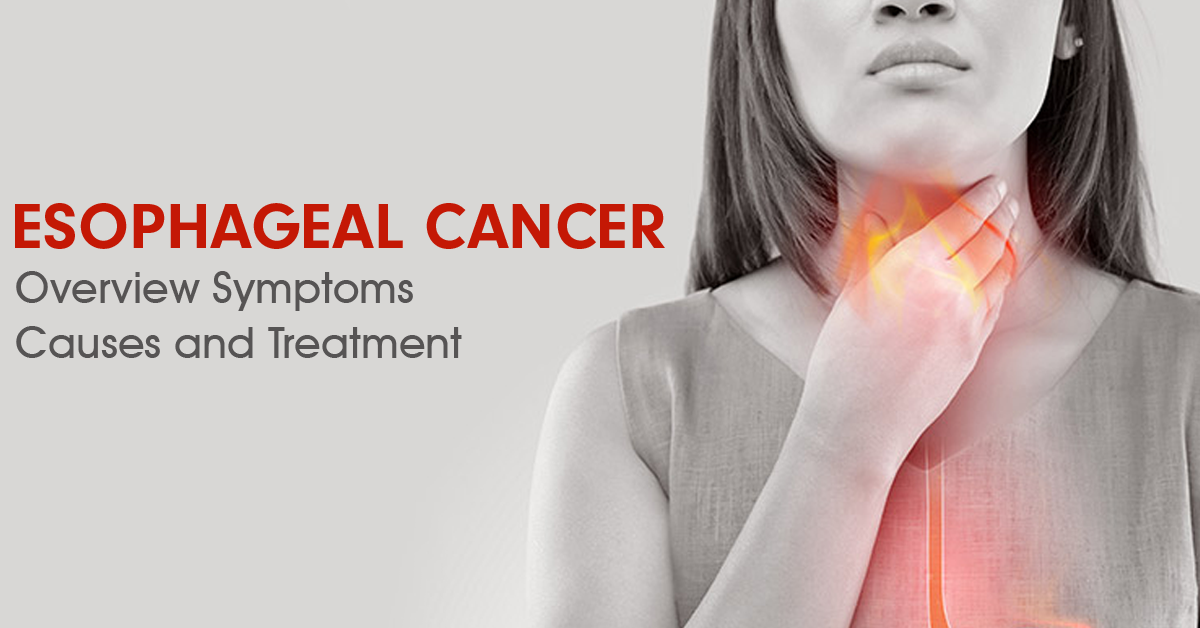
You must be aware of the fact that cancer is a disease which has the ability to affect almost every part of your body. Depending on your lifestyle and diet, your body may develop mutations which could make cells grow uncontrollably. This phenomenon causes cancer, and only being aware and having the knowledge could save someone from this disease.
One similar cancer disease is Oesophageal Cancer, which is a type of cancer that comes under the Gastro-Intestinal group of cancers.
Overview
The oesophagus is a tube that attaches the mouth and throat with the stomach (commonly known as “food pipe”). Mainly there are two types of cancers that can occur in the food pipe. Squamous cell carcinoma happens more usually in the upper or middle part of the oesophagus. Adenocarcinoma appears in the lower part of the oesophagus.
Symptoms
Very small tumours at an early stage do not usually cause symptoms. Patients generally experience difficulty swallowing as the tumour gets bigger and the width of the oesophagus becomes narrow. At first, most have trouble consuming solid foods such as meat, bread or raw vegetables. As the tumour grows, the oesophagus becomes more narrowed inducing difficulty in swallowing even liquids. Cancer of the oesophagus can also cause symptoms of heartburn, indigestion, vomiting and choking. Patients may also have coughing and hoarseness of the voice. Involuntary weight loss is also common.
Causes/Risk Factors
Studies show that oesophageal cancer is more usually diagnosed in people over the age of 55 years. Men are affected twice as generally as women. Squamous cell oesophageal cancer is more prevalent in African Americans than Caucasians. On the other hand, adenocarcinoma seems to be more common in middle-aged Caucasian men.
The exact cause is anonymous; however, there are well-recognized risk factors. As per the studies, smoking and obesity are the primary risk factors. Quitting drinking and smoking may decrease the chance of getting oesophageal cancer as well as other types of cancers. Seldom adenocarcinoma of the oesophagus runs in families.
The risk of cancer of the oesophagus is also enhanced by irritation of the lining of the oesophagus. In patients with acid reflux, where contents from the stomach back up into the oesophagus, the cells that line the oesophagus can switch and begin to resemble the cells of the intestine. This ailment is known as Barrett’s oesophagus. Those with Barrett’s oesophagus have a higher risk of exhibiting oesophageal cancer.
Few causes of irritation can also increase the risk of developing oesophageal cancer. For example, people who have swallowed caustic elements like lye can have damage to the oesophagus that increases the risk of developing oesophageal cancer.
Screening/Diagnosis
The doctor will generally start by taking a comprehensive history and conducting a physical examination. An oesophageal also called a barium swallow, is a series of x-rays of the oesophagus. The patient is directed to drink the barium solution, which coats the inside of the oesophagus. Multiple x-rays are then taken to look for differences in the shape of the oesophagus.
Most patients encounter a test called endoscopy where a thin flexible instrument with a camera at the end is passed inside the mouth into the oesophagus. This enables the doctor to examine the inner layer of the oesophagus. Biopsies can be exercised during this procedure if needed and presented to the pathologist for examination under a microscope to detect cancer cells.
A CT scan of the neck, chest and abdomen may help to identify if there is any spread of cancer to other organs in the body so that the doctor can plan proper management.
Endoscopic ultrasound is a way that can be used to provide a detailed evaluation of the depth of the tumour and involvement of nearby lymph nodes. This instrument is similar to the endoscope except there is ultrasound implanted at the tip of the scope. Fine needle aspiration under ultrasound administration can be performed on any suspicious lymph nodes that are seen.
Treatment
Depending on the degree of oesophageal cancer the patient may endure surgery, radiation and/or chemotherapy. Other domains that may improve symptoms include stretching/ dilation, tube prosthesis (stent) and radiation or laser treatment to reduce the size of cancer.
Doctors are actively looking at new ways of coupling various types of treatment to see if they may have a better effect on treating oesophageal cancer. Many patients with oesophageal cancer undergo some form of aggregate therapy with surgery, radiation and chemotherapy. Some patients at the very early cancer of the oesophagus may undergo an endoscopic resection of cancer without surgery using procedures such as endoscopic mucosal resection or endoscopic submucosal dissection.
Leave a Reply